Friday, March 8, 2024

Walking in Hawai'i Volcanoes National Park


Kilauea Iki Crater Overlook
author & artist L. Peat O'Neil
October, 2020

Thursday, August 13, 2020

Santa Clara de Cobre :: Copper Artisans in Mexico


Patzcuaro, Uruapan and St. Clara de Cobre. 

Lake at sunset


For a weekend excursion by car from Mexico City, follow the toll road west from 
La Capital towards to Toluca and Morelia to the towns of Uruapan, Patzcuaro and the magical artisan community St. Clara de Cobre.  

Lago de Patzcuaro is a volcanic lake and home to the early indigenous tribe that worked copper, said to be the only copper artisans in Central America. 
They used copper for their hatchets and other weapons as well as to make containers.  

Recommended buildings for visitors to visit in Patzcuaro include Casa de los Once Patios (House of the Eleven Patios), Biblioteca Gertrudis Bocanegra with the celebrated murals bv Juan O'Gorman and the Basilica.

The market area includes House of Eleven patios offers souvenir goods, however a few shops tucked away off the main walking route, do sell authentic hand-woven cotton cloth, copper containers and decorative creations, placemats, and inlaid wooden items.  
Survey the entire shopping area before buying, not to search for better prices, but unusual items or better quality work and design.

Tzintzuntzan is the meso-American archeological site above the town, the area of the Chichimecas tribes. Bring along a guidebook for historical perspective. In the town of Tzintzuntzan, the Franciscan Monastery grounds were planted by the Spanish monks with olive trees that are still growing there fine hundred and ten years later.  

In Uruapan, to the northwest of Park Eduard Ruiz which lies in a deep ravine, there’s a liquor store (address: 87C Pino Suares)  an outlet for the liquor factory, located outside of town.  They sell sugar cane liquor (aka rum or charanda), in various flavors.  Charanda Dorada el Terasco is a favorite. 

I bought coffee flavored liquor, remembering my student days in Toronto, when we would make the delicious potion at home with raw alcohol (Ever-Clear) and thick coffee syrup made with excessive doses of powdered espresso coffee concentrate.  You were supposed to let it cure for a few weeks, but I always seemed to crack open the bottle early.  Four months after buying this Mexican coffee liquor, it is still sealed.

In the copper shops in the village of Santa Clara de Cobre, you can watch artisans at work.  The fierce banging of mallets and shaping tools on the dense copper shapes could be a drawback for visitors, so bring ear plugs if noise bothers you.  This town is famous for the traditional artisans who work in copper. The nearby Copper Museum displays metal working tools set up and ready for use.

Ask to see the obsidian ornaments.  Copper bells and smaller objects are for sale.  The bells look a little like castanets and are similar to bells attached to grazing animals.  Oval in shape, with clapper covered by two oval sides.


Where to Stay: In Patzcuaro, the Hotel Posada Don Vasco, Best Western Hotel with pool, restaurant and attractive grounds.  Single room rates vary depending on the peso-dollar exchange rate.  Rooms numbers 501 to 507 have balconies overlooking gardens.  

Saturday, August 1, 2020

Congressional Cemetery


Sunday, April 5, 2020

Free Press? Dead Press:: Mexico's Dead Journalists


Mexico and the Free Press

Traditional media in Mexico practiced “press release journalism” in which reporters chronicle government announcements and activities based on information offered by the government.  Independent investigation was rare.  Some newspapers even treated the government issued press releases as advertisements, accepting payment for running the announcements. Still, there were journalists who were skeptical or posed investigative questions.  Yet regimes in control would deny access or control sources through intimidation or lack of response.

“In late 1990’s, the journalists often drew distinctions between government’s willingness to tolerate criticism, its willingness to furnish media with information that should reasonably be considered public.”  P. 38  Cantrell

Journalism in Mexico dates to 1722 when newspapers appeared, though scribes and writers have been chronicling daily life in Mexico since the arrival of the Conquistadores. For writers in Mexico, periods of repression alternated with periods of growth and access to information. Freedom to publish depended on the whim of government.

Today, a vigorous number of newspapers serves the reading public, but content can be anemic, partisanship obvious.  Though there are a few investigative papers pursuing active journalism, papers like La Jornada and Reforma. 

Until recently, reporters relied on government issued press releases for story sources and publishers bowed to official mandates on newspaper content.  A newspaper owner may be free to publish, but the content was controlled by the government. 

During the early decades of the 20th century, when the stated goals of the Mexican Revolution -- free public education, land reform and labor laws  -- signaled a wave of democracy in Mexico, newspaper editors who dared challenge the motives or actions of the leaders could be jailed or their presses shut down.  

Government tactics to control editors and journalists have changed during the 20th century. In the past an editor might be muzzled and jailed, but by the final decades of the 20th century, the editor or writer would likely lie bleeding or dead in the street for daring to identify corrupt officials or sponsor investigative reporting.

For example, back in 1925 and 1929, Don Silvestre Terrazas, a newspaper publisher in northern Mexico, was imprisoned and his presses padlocked.  He was charged with inciting rebellion or attacking public order.  Yet during the revolution, this Chihuahua native son of one of the powerful northern families had served as liaison between Pancho Villa and Venustiano Carranza, leaders of the insurgent armies in the north.  Don Silvestre had provided arms and ammunition to the revolutionaries, but when his newspaper El Correo de Chihuahua criticized the new government, his allegiances were nullified and his press padlocked.  (p. 87-88, Mexico: Ancient and Modern) 

By mid-20th century, corruption and subtle pressures were effective in controlling the media.  Journalists are informed of the ‘rules’ for maintaining presidential image and  advised in advance what issues could be addressed.  Papers that didn’t comply would suffer declines in advertising orders. Newspaper owners would dismiss a reporter who didn’t follow the ‘rules’ rather than suffer loss of financial support from the government advertising revenues. (p. 40, Lawson)  

Direct threats to journalists ensued. “…(R)elatively mild punishments were usually sufficient to drive independent media into compliance or out of business. … Organized official repression was seldom necessary.” While the last few years have seen a slacking of the “la mano dura”  (the iron hand), corrupt officials who feared exposure by emerging independent media had turned to violent repression.  Especially during the 1980’s, 60 journalists were murdered between 1980 and 1996. In 1986, Mexico claimed the dubious fame of the highest rate of journalists murdered in world. (p. 45 - 46 Lawson)

Though the violence, kidnapping and intimidation continues, the last ten years have brought improvements in access to information and protection from retaliation by corrupt officials. The emergence of international human rights organizations and vocal advocates for journalists focuses global attention on the perils of being a journalist in Mexico. Journalists in Mexico still practice their profession hampered by restrictive libel laws that carry jail terms and heavy fines.  Officials continue to be reluctant to submit to transparency laws and there’s a continuing attitude of opposition to investigative reporting.


www.article19.org   - Article 19 The Global Campaign for Free Expression

www.cidh.org   -  OAS, Freedom of Expression, Annual Report 2002 

http://www.gwu.edu/~nsarchiv/NSAEBB/NSAEBB68/  - National Security Archive


www.ijet.org  -  Knight International Press Fellowships


http://www.pulso.org - Pulso de Periodismo

http://www.internews.org/ - Manuel Buendia Foundation

http://us.politinfo.com

http://www.planeta.com/ecotravel/period/pubmexnews.html - Mexico News Seminar


www.sipiapa.org  -  Inter American Press Association (IAPA)

www.rsf.org  -  Reporters Without Borders/Reporters Sans Frontieres


www.cpj.org   - Committee to Protect Journalists

www.cipe.org/pfc  - Journalists Against Corruption

www.editorandpublisher.com   - Editor and Publisher Magazine

Columbia Journalism Review, NY, Jan-Feb, 1997, "A Freer Press Scares the
Government," Joel Simon


Toward Freedom Magazine, Dec. 98-Jan 99, “Killing the Messengers,” Ron Chepesiuk  www.towardfreedom.com


The Media Crisis…A Continuing Challenge, World Press Freedom Committee,
www.wpfc.org  World Press Freedom Committee


Lawson, Chappell, Building the Fourth Estate: Democratization and Media Opening in Mexico, Univ. of California Press, 2002

Morris, Stephen D., Corruption and Politics in Contemporary Mexico, 

Univ. of Alabama Press, 1991

Mexico: Ancient and Modern, An exhibition celebrating the acquisition of the Silvestre Terrazas Collection, Friends of the Bancroft Library/U of Cal Berkeley, 1962


Monday, December 16, 2019

Topography of Michoacan Mexico


Michoacan 

It’s said the people of Michoacan were the most difficult for the Spanish to conquer.  Perhaps because they were artisans, well organized and could provide food for themselves during privation.

Topography may be a better indicator.  Depression in landscape (neatly mowed) in this archeological site suggests carefully sculpted layouts for the foundation footings for pyramids.  The pleasant view of the lake suggests those of the princely rank had first choice of  residences overlooking the water, with mountains behind and the sky forming a panorama.  One thing is sure, the mountains haven't changed.  The layout reminds of Lake Toba, the island in the center of a volcanic lake on Sumatra, part of Indonesia.

Around the pyramid the stones were fitted by trimming which required force. Or possibly the ancient builders used water and grindstones to shape the squared stones. This is my idea, no guidebook suggests how random rocks become fitted stones to build elaborate structures.  It is difficult to imagine people chipping away at stones to shape them..  The ruined patio is surrounded by open rooms with column footings on which the roof was set.  Reconstructed along antique lines there’s a small line of stones set in the wall where the reconstruction starts.  

A turtle shape is part of the monument.  To Yacatecs this is the Temple to God of Viento (the winds).  I notice the iconic protection of turtle shell.  Shell forms are called the concha, and signify the sacerdote/ritual priest’s protection.

Black earth, red earth town called Tzin Tzun Tzan near Patzcuaro is filled with artisans.  Their activities form an important part of the local economy.   


Saturday, November 16, 2019

Malinche National Park :: Mexico


La Malinche is Mexico’s fifth-highest peak at 14,636 feet, some 20 miles north of Puebla.  The summit is higher than any peak in the contiguous United States.  Many climbers use La Malinche as an acclimatization hike for other higher altitude volcanos nearby. like Ixta  and Pico de Orizaba (18,400) which is the highest mountain in Mexico. 

La Malinche, which was the name of the conquistador Hernan de Cortes’ mistress,  requires 4 or 5 hours for a summit.  The hike is about 5 miles and 4,000 feet gain. Matacoula, the goddess of rain, might well be the real name of the mountain. La Malinche being a corruption or derivation of the ancient name.

Many climbers camp in the La Malinche National Park recreation area.  The park also rents brick and stucco cabanas / cabins that sleep 6 or 9 people with prices depending on the season or size of the cabana.  Setting up a low-fee campsite the afternoon before the climb and sleeping at the park enables a 4:30 or 5 a.m. start for the hike.  Campers and cabana guests should bring appropriate clothing and sleeping bags for very cold nights.  The recreation area includes basketball courts, souvenir shops, a restaurant and rustic conference facilities.

During rainy season, the air cools down fast and washout creates potential safety hazards.
There are gullies cut alongside hiking path to allow for water runoff, but experienced hikers wait until dry season (Nov-March) for mountain excursions.   he mountain below the tree-line is densely covered with eucalyptus, conifers and dense rather attractive undergrowth.  Birds sing tantalizing melodies overhead but they stay out of sight.

At one time, glaciers covered the peak.  Now, the volcano appears to be mostly green, though there is a barren zone above 4,000 meters.  Climate change has erased the ice cap at the top for the most part.  The terrain around the base is sandy soil, corn fields, pink and purple wild flowers that might be Coreopsis family.


Directions to La Malinche.

From La Capital (Mexico City), take the "Cuenta" (toll road)  (Rt. #1500  towards Puebla. For a break, stop at Restaurant Rio Frio or Panorama Restaurant on the right.

Take the right hand turnoff towards Tlaxcala.  Continue towards signs indicating Apizaco/Veracruz (Rt. #117). Continue on the Rt. #136 towards Veracruz.
 Turn right at exit direction towards Huamantla. (near an “Acerocarbon” factory). Drive some kms more,  pass “El Tigre” sign on left side of road. Malinche volcano appears on right during this part of journey. The "Milintzi” sign indicates entry to park.

Other towns around the perimeter that appear to lead to paths:  San Juan Ixtenco, San Pablo del Monte, Trinidad Sanchez Santos, San Miguel Canoa.

Alternate route, in direction of San Miguel, go past ruins of a huge hacienda.  Sign “Tampico Restaurant Bar”.  This is a good area for sketching or painting views of Malinche.


Resources:

http://www.imss.gob.mx/servicios/centros-vacacionales/malintzi


Saturday, December 1, 2012

Kyudo::Japanese Archery in Mexico City


Kyudo Kai form - fully drawn bow.


Master of Kyudo,  Sensei  Ali Zolfagharian teaches  lessons on kyudo -- Japanese archery -- in Mexico City.  Kyudo is radically different than archery I'd practiced in high school.  Our group of dedicated archers would meet on Sunday mornings at the UNAM campo de tiro con arco.


Kyudokai Mexico sponsored the classes.
Kyudo involves a very ceremonial series of movements which you practice for months before drawing the bow back.  Each movement is part of a set form and follows an exact sequence of foot and body placement through an entry processional to the archer's position.  After you practice the form and understand the body posture, you can practice drawing the bow which was somewhere around eight feet long.  


One Arrow, One Life -- the essential text on Kyudo.
You can study kyudo for years and will always be a beginner.  It's one of those disciplines, like tai-chi or yoga that becomes part of your life and calms the mind.

Skill depends on a clear memory and the ability to move in harmony with others during the entry and exit processionals.  With careful practice, the candidate advances.  


Upper body muscles may need development to engage in the demands of kyudo.  Ali Zolfagharian, the instructor,  provided a length of elastic stretch rope so I could practice the full bow opening movement.   This You Tube video displays the kyudo form.  


Wednesday, November 21, 2012

Organic Materials for Chinese TraditionalMedicine.
Photo:Wikipedia.

Toronto's Chinese Pharmacy


When you’re looking for pulverised dragon bone,
yak horn or aged ginseng, the local drug store just won’t do. 
The pharmacy to visit is in Toronto, Canada.  
It may be farther than the local mall, but compared
to jetting across the Pacific, Toronto is just around the corner.


Dundas Street is a busy east-west artery through
Toronto's Chinatown, a vigorous commercial segment
in a dynamic city. The Chinese drugstore I visit is 
South China Herbs Market, near the intersection
of Dundas and Spadina, in a neighborhood
teeming with chic cafes, galleries, clothing outlets, ethnic restaurants
and international food markets. There are other
Oriental pharmacies close by, and almost any 
city in the U.S. and Canada with a large Chinese population will have reliable stores selling
Oriental medical supplies.  But I like the continuity of
visiting the same herbal emporium for three decades.

Inside the brightly-lit ground level store,
colorful boxes covered with Chinese characters 
are stuffed in floor to ceiling shelves. Teas,
herbal compounds, and beauty treatments share space
with aphrodisiacs and hair restoratives.  As in any
drug store, the products promise to make you smell,
look and feel better.  

Another customer with gray hair smoothed
back from her unwrinkled brow smiles at me
and taps the jar of Lion Balm on the counter.  It's a Korean version of
Singapore’s famous Tiger Balm, an aromatic salve.
The sales clerk tells me the old lady
is commenting on my choice of Lion Balm, “such a
wonderful product.”  I smile politely and also buy
one of the little plastic jars of the no-name brand the woman is testing, 
just in case the old lady was really saying, 
“only foreign devils are so dumb they buy Lion Balm."

I discovered South China Herbs during the 1970s. At
the time I suffered from sciatica, a condition that flared after 
a violent car accident.  The nerve that runs from hip to heel at the back of
the leg roared with inflammation. After an orthopedic surgeon prescribed industrial grade Motrin that upset my stomach, I tried acupuncture, shiatsu massage, exercises and aspirin, but the shooting nerve pain persisted. 

While in Toronto, I noticed the Chinese
pharmacy and explained my chronic problem to the
counter clerk.  She brought ginseng tea and led me
to the back of the shop. Seated in the closet-size
consulting room, I described my symptoms while an
elderly Fu-Man-Chu look-alike stared at me, felt my pulse,
examined my eyelids and skin temperature.  He chattered questions
while the counter clerk translated. 

The old pharmacist scribbled columns
of characters on a pad of paper. 
Just so you know prescriptions in Chinese characters are just as illegible as those written by English speaking healers.

Choosing from many packages of herbs, organic
powders, insect corpses, bark, dried blossoms,
leaves and sea urchins, the pharmacist mixed
four doses of my treatment. The translator explained how
to prepare the potions and cautioned me to drink them
all, even if they tasted bad.  They wrapped the piles of
dried stuff in white paper and heat-sealed plastic.


I boiled, strained and drank the vile-tasting black potion as directed.
To my surprise – I wasn’t a believer yet -- the sciatica pain waned.  On
the rare occasions it flared up, I used topical
remedies such as medicinal plasters that I found at South China Herbs.  Ever since, I’ve been a return customer and share the remedies with my friends who shun invasive western medicine.


The medicinal plaster is a wide sticky tape
impregnated with healing lotion used for lower back
pain, joint aches, nerve pain and rheumatism. The
instructions include line drawings of people applying 
squares of plaster to knees, lower back, shoulders and ankles. 
The translation claims the plaster relieves complaints
from poor circulation to slipped disc, 
but you probably want to take that slipped disc for high-tech diagnosis.


The main attraction at South China Herbs are the shelves
crammed with mysterious organic elements wrapped
in paper or cloth, stored in jars and boxes. 
Take away the florescent lights and you could be in
a medieval alchemist's den. In fact, Chinese herbal
medicinals date back at least 3,000 years in 
written records and earlier in the oral tradition.
The compounds are used by about a fifth of the
world's population.


The custom-mixed herbal remedies are expensive and 
to be reasonably effective, the potions should be consumed for several days.
Treatments work best on conditions such as
insomnia, fatigue, circulatory disorders, muscle
pain, skin ailments, joint aches, nerve
inflammation, discharges and swellings. While the
Chinese drugstore is not the place to look for
cures for AIDS or cancer, their products are
effective on general low-grade complaints brought
on by lifestyle or environmental exposures. 


South China Herbs Market, 493 Dundas St. W.
Toronto, Ontario Canada M5T 1H1, 416-596-8527. 

Monday, November 5, 2012

Rex Hotel, Ho Chi Minh City

Rex Hotel, HCMC © L Peat O'Neil


The Rex, in downtown Saigon -- now Ho Chi Minh City -- was the hang out spot for newspaper correspondents, military "advisors" and Quiet Americans during the Vietnam War.  


Built in 1927 as a car dealership and showroom during the French colonial era, the Rex Hotel gained a few floors and became a hotel just in time for the arrival of U.S. Army soldiers and specialists in 1961.  During the war, journalists gathered to wash down their cynicism as unrealistic progress reports were delivered by military officials to the press.

After that war ended in 1975, the city tourism bureau took over the hotel.  By the mid-1980s, tourists and business entrepreneurs looking for trade opportunities were staying there. The rooftop restaurant-bar offers terrific views, drinks with paper parasols and an atmosphere not available elsewhere.

Monday, October 29, 2012

Medical Geography

2012 Outbreaks of hantavirus in USA.
Medical Geography

Several decades ago, when I worked as budget officer and research assistant in the University of Toronto Department of Epidemiology and Preventive Medicine (now part of the U of T Dalla Lana School of Public Health),  the term Medical Geography circulated in scientific discussion, but not the general press.  Medical cartography --  mapping disease  -- dates back at least a couple of centuries.  Modern analysis of the relationship of geography to climate change and the distribution of disease is now a sub-specialty of geography.

Quarantine area for ebola infected patients. 
Medical Geography goes beyond a look at annual flu epidemics that typically originate in South East Asia or the endemic diseases of Africa.  The discipline of Medical Geography includes study of climate, weather, seismic events and other disasters, forced and voluntary migration as it relates to the trajectory and movement of disease.  


Disease tracking and analysis in recent decades - for the outbreaks of  Hantavirus, Ebola, West Nile virus, Avian Flu and SARS, among others -- reveals that climate change does impact how diseases move because of changing habitat patterns for the carriers of these potentially deadly pathogens. Mass migration and refugee movements and tourism also expand the range of human vectors. 

Deer mouse - carrier of Hantavirus.

Can indigenous Malaria really be returning to Italy?  Tropical zone insects are moving to Italy ... a bad air indeed.


Saturday, September 1, 2012

Diego Rivera and His Idols


Museo Anahuacalli, Mexico City
A Home For My Idols


The second dream, one of thirty-five years’ standing, was renewed by the destruction wreaked everywhere by the war.  It was to build a home for my anthropological collection, which I had started to assemble on my first return to Mexico in 1910.


So while the bombs menaced our very lives and made painting seem a thing of insignificance, Frida and I started a strange kind of ranch.  Here we planned to raise our own food staples, milk, honey, and vegetables, while we prepared to build our museum.  In the first few weeks, we erected a stable for our animals.   [Really? Can you see Frida or Diego actually wielding hammers themselves? Perhaps they hired workers, ummmm?]  

The side we chose was near Coyoacán, right on top of a lava bed.  Cactus sprang up profusely from the crevices in the stones.  Nature had landscaped the area as if for one purpose, and I decided that our house should be in harmony with her work.  Accordingly, we cut our stone from the basalt indigenous to the region.  The structure would rise from the earth like an extension of its natural surface.

I designed the building in a composite of Aztec, Mayan, and “Rivera Traditional” styles.  The squarely built exterior resembles an ancient Mexican pyramid of the pre-Cortes period.

Mask of Thaloc © BritishMuseum.org
The main floor is the museum where my sculptures of this period are displayed.  The rooms here wind and open into each other like those of a labyrinth.  Walled in unfaced stone, they are gray and dank.  On the ceilings are white stone mosaics, mainly abstract in form.  One of the mosaics, however, is of the rain god, Tlaloc, whose face I represented as a formation of two wriggling snakes.  


The upper section is still to be completed.  I intended it as my studio, where I could create my own sculptures to adorn the outside walls.  But lack of time and money have so far prevented me from carrying out this part of my plan.

Surmounting all is a tower representing the god of air and open on all sides to the raw, cool drafts of mountain air.  The cool and stony aspect of the place gives one the impression of being in an underground temple.

During the war, this building was “home” for Frida and me.  After the war, it was converted exclusively into a home for my idols.  Guided by Dr. Alfonso Caso, Mexico’s leading anthropologist, I passed many wonderful hours placing my statues in chronological order in the different rooms of the building.  Dr. Caso and his associates were enthusiastic about my collection, declaring that while my dating of some pieces might be in error, I had shown an uncanny instinct for what was authentic and important.  They rated the collection among the best in the world.

This venture, however, has almost impoverished me.  The cost of maintaining the museum has been about $125 a week.  With this outlay added to the $300 a month I gave Frida for household expenses for our home in Coyoacán and the forty dollars a month I paid for my daughter Ruth’s college tuition, I was left with hardly enough change to buy the daily newspaper.

People are under the impression that I am wealthy because I have sometimes paid as much as $250 for a single idol.  But when I have made such a purchase, I have often, as a result, had to scrimp on necessities.  Frida used to scold me sometimes for not keeping enough money to buy such prosaic things as underwear.  But my idols have more than compensated me for their expense.  Whenever I feel disgusted with some painting I have done, I have only to look at them and suddenly I feel good again.

By now, I have already spent more than fifty thousand dollars on the museum and still it is not complete.  Most visitors are astonished to hear this low figure.  However, I did so much myself:  the architectural designs, the engineering, and even the overseeing of the actual work, thus cutting the cost of construction considerably.

Since beginning the project, I have put into it literally every penny I have earned above modest living expenses.  Work on the museum halted during Frida’s illnesses, when the heavy medical and hospital bills virtually bankrupted me.  However, when Frida was well and earning money from her own paintings, she would refuse to accept any money from me, and I would go on idol-buying sprees.  All in all I have spent about one hundred thousand dollars on my collection – apart from the building itself.

I calculate that another forty thousand dollars will be required to complete the building.  My plan is to give the museum to the state, provided it appropriates the money needed to finish it.  My only other stipulation will be that I be allowed to supervise the final construction.  If I cannot arrange a mutually satisfactory agreement with the authorities, I shall dynamite the building with my own hands rather than have it put to some stupid use at odds with the purpose for which I designed it. (p. 250-252)


Rivera, Diego, with Gladys March. (1960). My Art, My Life. An autobiography. New York: The Citadel Press, pp 250-252.


Wednesday, August 1, 2012

Walk in West By God Virginia :: Dolly Sods

Dolly Sods

After buying topographic maps for the Dolly Sods region at the visitor's center near Seneca Rocks, we returned to hike the sods. Up front, you have to know that Dolly Sods has nothing to do with Dolly Parton. The name relates to the Dahles family, local homesteaders.  The acidic soil, elevation and scrub flora creates a micro eco-system that suits blueberry and cranberry bushes that carpet the plains. So we hunkered down and stuffed ourselves with blueberries. At first they were difficult to see, but as we nosed past the myopia frontier, we filled handfulls of flavorful berries.
Dolly Sods Wilderness.  © FWS.gov

Light green or grey slabs of reindeer moss grow beneath the blueberries on either side of the path.1 Though posters warning about rattlers and copperheads adorn every bulletin board in the Sods, the only snake I saw was a tender green garden snake startled by the screech I involuntarily emitted.

As we passed through Petersburg on the way home, a parade brought traffic to a standstill for two hours. The Tri-County Fair was opening that evening and the whole town was out to cheer a procession of big-rig trucks, vintage cars and floats advertising local businesses and churches. Blending in with the crowd and watching the passing scene was the only sensible option. Kids scrambled for penny candy tossed by drivers in the parade. Young cowboys pranced up and down Virginia Ave. threading their horses through the motor vehicles.

The highlight was a horse-drawn 19th century funeral casson which we had noticed at Shaffer Funeral Home in Romney, WV earlier in the day.  My travel companion helped lift the axel so Mr. Shaffer could grease it.

As we watched the festivities, a man next to us propped against the stone wall -- our impromtu viewing stand -- urged his daughter to fill her sack with candy and leaned over to ask, "So, did you folks come down from the city just to see this parade?"  Heck, we thought we looked like locals.

Resource: The North Fork Mountain Inn offers silence, gracious mountaintop lodging and sweeping views of the surrounding forests.

See: High Beam for the full article.  The author receives no revenue.

Wednesday, July 4, 2012

Monticello :: Thomas Jefferson's Masterwork


Charlottesville’s favorite son, Thomas Jefferson, left more than a theoretical mark on the nation and the world.  The ambitious abstractions he wrote in the  Declaration of Independence remain the international benchmark for democratic standards of government and civil liberty.


Jefferson also championed the western explorations of Meriwether Lewis and William Clark that began in 1803.  


Jefferson's Library at Monticello © LOC.gov
Jefferson's ideas about individual liberty and intellectual and religious freedom will likely be debated and interpreted through the channels of justice and government  for centuries to come.  He wrote the statute of religious liberty for Virginia and founded the University of Virginia.  The inscription he wrote for his grave at Monticello doesn’t mention it, but Jefferson also served the nation as Ambassador, Vice-President, President and counselor to Presidents.   His library formed the nucleus of the Library of Congress.

The third President of the United States described himself as a planter and architect, wrote copious notes on his agricultural experiments collected in the “Garden Book.”  The best place to see the man behind the public servant is at Charlottesville and in particular, the home Jefferson designed and built, Monticello.  

Jefferson’s practical and tangible achievements  - the innovative architectural designs,  farming techniques and educatioleal plans - endure and inspire at Charlottesville, a peaceful town east of the Blue Ridge Mountains and Shenandoah National Park,  about 70 miles west of Richmond, the capital of the Commonwealth of Virginia 

Watercolor of Monticello in 1827. © LOC.gov
Named for King George III’s consort Charlotte Sophia, the town was settled in the 1730’s as a tobacco trading center.  Despite Jefferson’s then radical theories of democratic government, town sympathies must have tended to the Royalist position and British troops were billeted at Charlottesville during the Revolutionary War.

Jefferson’s beloved Monticello, built on land inherited from his father,  demonstrates his dedication to architectural symmetry.   Jefferson design for the house and  many of its furnishings focus on efficiency - beds are built into walls, placement of windows and doors takes advantage of  natural light and prevailing breezes. Hung in the entry hall are artifacts from the western explorations of Meriwether Lewis and William Clark  The bookshelves hold beautifully bound  editions that replicate Jefferson’s library. His own books were sold to the U.S. government to pay mounting personal debts and formed the nucleus of the Library of Congress. 
Monticello  © NPS.gov
A tour of the plantation is instructive for understanding the need for self-sufficiency and the importance of contributions by the slaves.  Though Jefferson wrote that he detested the institution of slavery, he remained a slaveholder.  However he improved conditions of his own slaves beyond the standards then accepted in Virginia.  Activity on the plantation  centered in the dependencies along Mulberry Row  where slaves and indentured servants lived and worked in the laundry, dairy, weaving house, carpentry and nail making shops and toiled at all the other crafts necessary to keep the plantation self-sufficient.   Jefferson’s extensive vegetable garden and orchards have been magnificently restored over the past fifteen years.

Wednesday, May 23, 2012

Hawai'i Images March 2012

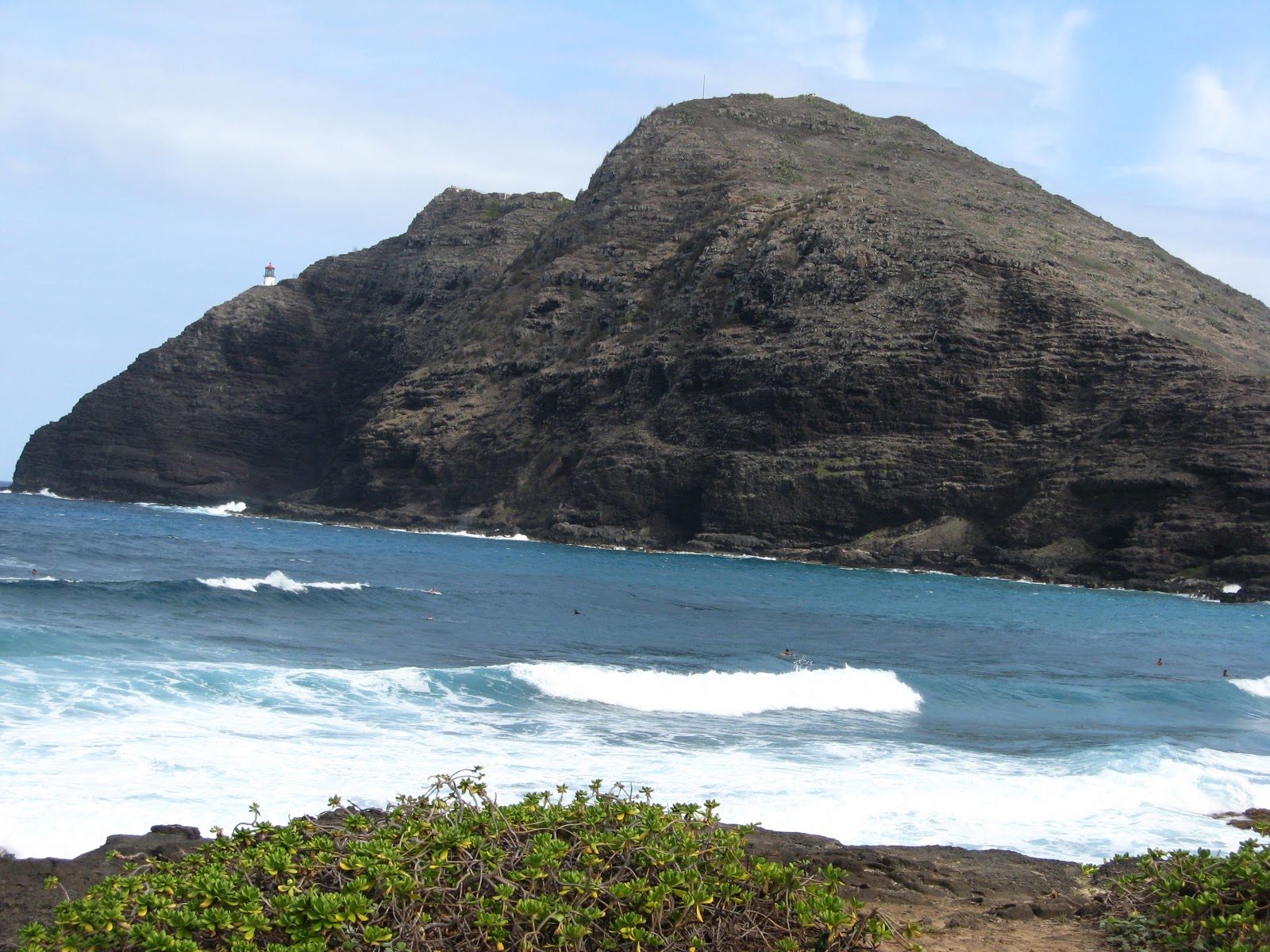
Rabbit Is. in distance, off east Oahu


Peer closely and see the whales.


Kaua'i Hindu Temple guardian.


See Kaua'i rainbows every day.


On the way to full moon crystal bowl vibration healing ceremony.


Memorial to the Hawai'ian nation and the spirit of the land usurped by ... oh, read about it yourself.


Rabbit Island - does the island look like a crouching island to you?


Surfers waiting....


Dry side = east side Oahu

Night sky photographer and friend Pat who showed me around.